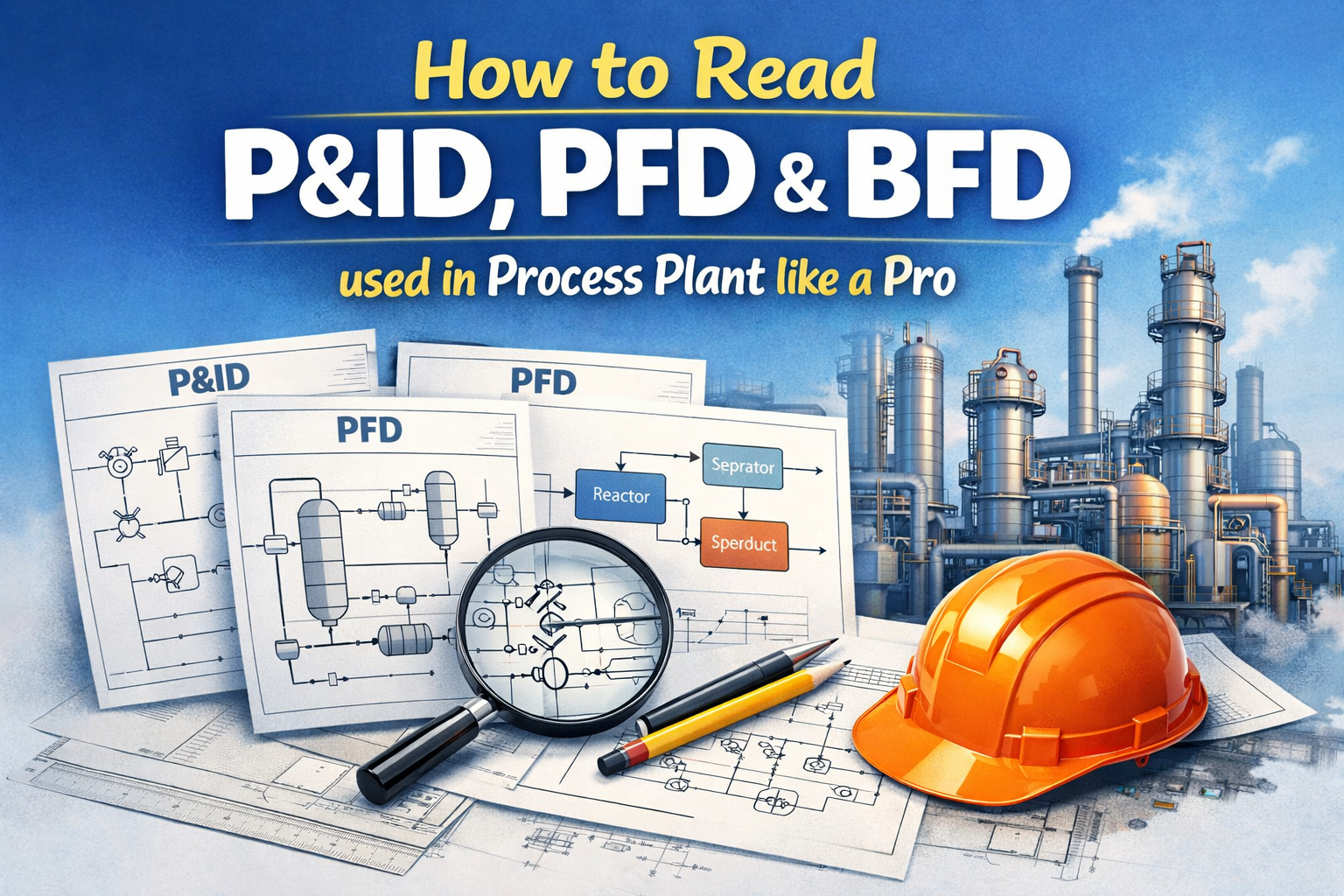
P&ID, PFD & BFD: The Skill That Separates Average Engineers from High-Paid Professionals:
Let me be straight with you.
I’ve seen engineers walk into a plant—oil & gas, chemical, even power—and freeze when someone hands them a P&IDs.
Not because they’re not smart.
But because no one actually taught them how to read a p&id diagram in the real world.
And in the U.S., that’s a big problem.
Because whether you’re dealing with pfds, troubleshooting a pump failure, or reviewing a piping and instrumentation diagram, this skill is expected—not optional.
👉 If you want to fix that fast:
👉 Click here to enroll now: [How to Read P&ID, PFD & BFD used in Process Plant like Pro]
Why This Skill Matters in the US (And Why You Can’t Ignore It):
In industries across the United States—like Texas refineries, California chemical plants, and offshore rigs in the Gulf—P&IDs reading is a core skill.
If you’re working in:
- Oil & Gas
- Chemical Processing
- Power Plants
- Manufacturing
You will deal with p&ids piping and instrumentation diagram daily.
Real Numbers (US Market):
- Entry-level engineers: $65,000 – $80,000/year
- Experienced engineers: $90,000 – $120,000+
- Senior / Lead roles: $130,000+
Here’s the truth:
👉 The engineers who understand instrument diagram, control loops, and piping and instrumentation drawing clearly…
👉 They get promoted faster. Period.
What is a P&IDs (And Why It Confuses So Many People):
A P&IDs (piping and instrumentation diagram) is not just a drawing.
It’s the language of the plant.
It shows:
- Equipment
- Piping systems
- Instruments
- Control loops
- Safety systems
But most people only know the theory.
They don’t know how to:
- Read a pid drawing during shutdown
- Trace a valve in a p and id diagram
- Understand logic in a smart p&id system
That’s where this course comes in.
What You’ll Learn in This Course (Practical, Not Theory):
Course: How to Read P&ID, PFD & BFD used in Process Plant like Pro
This isn’t textbook learning. It’s real plant-level understanding.
Here’s what you’ll actually gain:
- How to read a p&ids diagram step-by-step (even if you’re a beginner)
- Difference between BFD, PFDs, and P&ID (clear and simple)
- How to interpret instrumentation piping and control loops
- Understanding symbols used in piping & instrumentation
- Real examples from industry-standard tools like:
- autocad p id
- solidworks p&id / p&id in solidworks
- visio piping and instrumentation diagram
- cadworx p&id
- intelligent p&id systems
- How engineers use pid diagrams during troubleshooting
- How to confidently read any piping pid in a plant
👉 If this is what you need:
👉 Click here to enroll now: [How to Read P&ID, PFD & BFD used in Process Plant like Pro]
Who Should Take This Course:
This course is perfect if you are:
- Mechanical Engineers
- Chemical Engineers
- Instrumentation Engineers
- Fresh Graduates aiming for US jobs
- Plant operators or technicians
- Anyone searching for p&id for dummies but wants real knowledge
Even if you’ve never opened a p and id drawing, you’ll be fine.
Real Benefits (Career + Money + Confidence):
Let’s talk real outcomes.
After learning this skill:
- You’ll stop feeling lost during plant discussions
- You’ll understand meaning of p&id clearly
- You can confidently read any instrument p&id
- You become valuable during shutdowns and audits
And most importantly:
👉 You become hard to replace
That’s what drives:
- Promotions
- Salary hikes
- Job security
Why This Course is Worth It
What makes this course different:
- Simple explanations (no confusing jargon)
- Real plant-based examples
- Covers pfd, bfd, and p&id reading together
- Includes tools like creo pipe, solidworks electrical p&id, and more
- Focused on real-world usage—not just diagrams
👉 Don’t wait until you struggle in your job:
👉 Click here to enroll now: [How to Read P&ID, PFD & BFD used in Process Plant like Pro]
👉 Ready to Upgrade Your Skills?
If you’re serious about your career, don’t overthink this.
👉 Click here to enroll now: [How to Read P&ID, PFD & BFD used in Process Plant like Pro]
This is one of those skills that pays you back for years.
Frequently Asked Questions (FAQs):
1. What is a P&IDs in simple terms?
- A P&ID (piping and instrumentation diagram) shows how equipment, pipes, and instruments are connected in a process plant.
2. What is the difference between PFD and P&IDs?
- PFDs show the overall process flow, while P&ID gives detailed information about piping, valves, and instruments.
3. Is P&IDs important for mechanical engineers?
- Yes. Understanding p&id piping and instrumentation diagram is essential for plant jobs and design roles.
4. Can beginners learn P&IDs reading?
- Absolutely. This course is designed even for those searching p&id for dummies.
5. Which software is used for P&IDs design?
- Common tools include autocad p id, solidworks p&id, cadworx p&id, and visio piping and instrumentation diagram.
6. What is intelligent P&IDs?
- An intelligent p&id includes data-linked components used in modern digital engineering systems.
7. How long does it take to learn P&IDs?
- With the right course, you can understand fundamentals in a few days and gain confidence within weeks.
8. Is P&IDs used in the US industry?
- Yes, across oil & gas, power, and manufacturing sectors.
9. What is the meaning of P&IDs?
- It stands for Piping and Instrumentation Diagram.
10. Will this skill increase my salary?
- Yes. Engineers who understand p&id reading are more valuable and often earn higher salaries.