The Day the Pump Stopped — and Everything Did Too:
Picture a manufacturing plant in Houston, Texas. It’s 2 a.m. A centrifugal pump fails. Water stops flowing to the cooling system. Within minutes, equipment overheats. Production halts. Engineers scramble. The cost? Tens of thousands of dollars — and that’s before the repair bill.
This is not a rare scenario. Pump failures are one of the leading causes of unplanned industrial downtime across the United States. From oil refineries in Texas to water treatment plants in Ohio, centrifugal pumps are the unsung engines that keep industries moving.
Here’s the thing — most failures are preventable. They happen because the people operating and maintaining these pumps don’t fully understand how they work. If you want to stand out in today’s job market, understanding centrifugal pump principles isn’t optional. It’s a career advantage.
👉 Start learning Centrifugal pumps : Principles , Operation and Design course here: https://trk.udemy.com/2RdK77
👉 Get full subscription access: https://trk.udemy.com/PzKGrq
What Is a Centrifugal Pump? (Simple Explanation):
A centrifugal pump is a mechanical device that moves fluid — usually water or chemicals — by using a rotating component called an impeller. It converts the energy from a motor into fluid velocity, pushing liquid from one place to another.
In plain English: think of it like a spinning fan — but instead of moving air, it moves liquid.
You’ll find centrifugal pumps in:
- Water treatment and municipal supply systems
- Oil & gas pipelines and refineries
- HVAC and building cooling systems
- Chemical processing plants
- Food and beverage manufacturing
- Pharmaceutical production facilities
They’re everywhere. And every industry that uses them needs trained professionals to run and maintain them properly.
How Centrifugal Pumps Work — The Core Principle:
Here’s the simple version: a motor spins the impeller inside the pump casing. As the impeller rotates at high speed, it flings the fluid outward using centrifugal force — the same force that pushes water to the edge when you spin a bucket.
That outward-moving fluid creates a low-pressure zone at the center (the eye of the impeller). This pulls more fluid in from the inlet. The fluid then exits through the discharge outlet at higher pressure and velocity.
This continuous cycle is what allows the pump to move enormous amounts of liquid — consistently, efficiently, and reliably — when the system is properly designed and maintained.
👉 Start learning Centrifugal pumps : Principles , Operation and Design course here: https://trk.udemy.com/2RdK77
👉 Get full subscription access: https://trk.udemy.com/PzKGrq
Step-by-Step: How Centrifugal Pumps Operate:
Understanding the operation sequence helps you catch problems early. Here’s how a typical pump cycle works:
- Step 1: Priming: The pump must be filled with liquid before starting. Running it dry damages the impeller.
- Step 2: Motor Startup: The electric motor (or engine) begins spinning the shaft connected to the impeller.
- Step 3: Fluid Intake: Rotation creates low pressure at the inlet, drawing fluid into the pump casing.
- Step 4: Energy Transfer: The spinning impeller accelerates the fluid, adding kinetic energy.
- Step 5: Discharge: Fluid exits through the outlet pipe at increased pressure, flowing to its destination.
Common Operational Mistakes to Avoid:
- Running a pump dry — destroys the mechanical seal and impeller fast
- Cavitation — bubbles form when inlet pressure is too low; they collapse violently and damage metal parts
- Incorrect flow rate — pushing a pump beyond its design range reduces efficiency and lifespan
- Ignoring vibration — early vibration is often a sign of bearing wear or misalignment
Key Components and Why Design Matters:
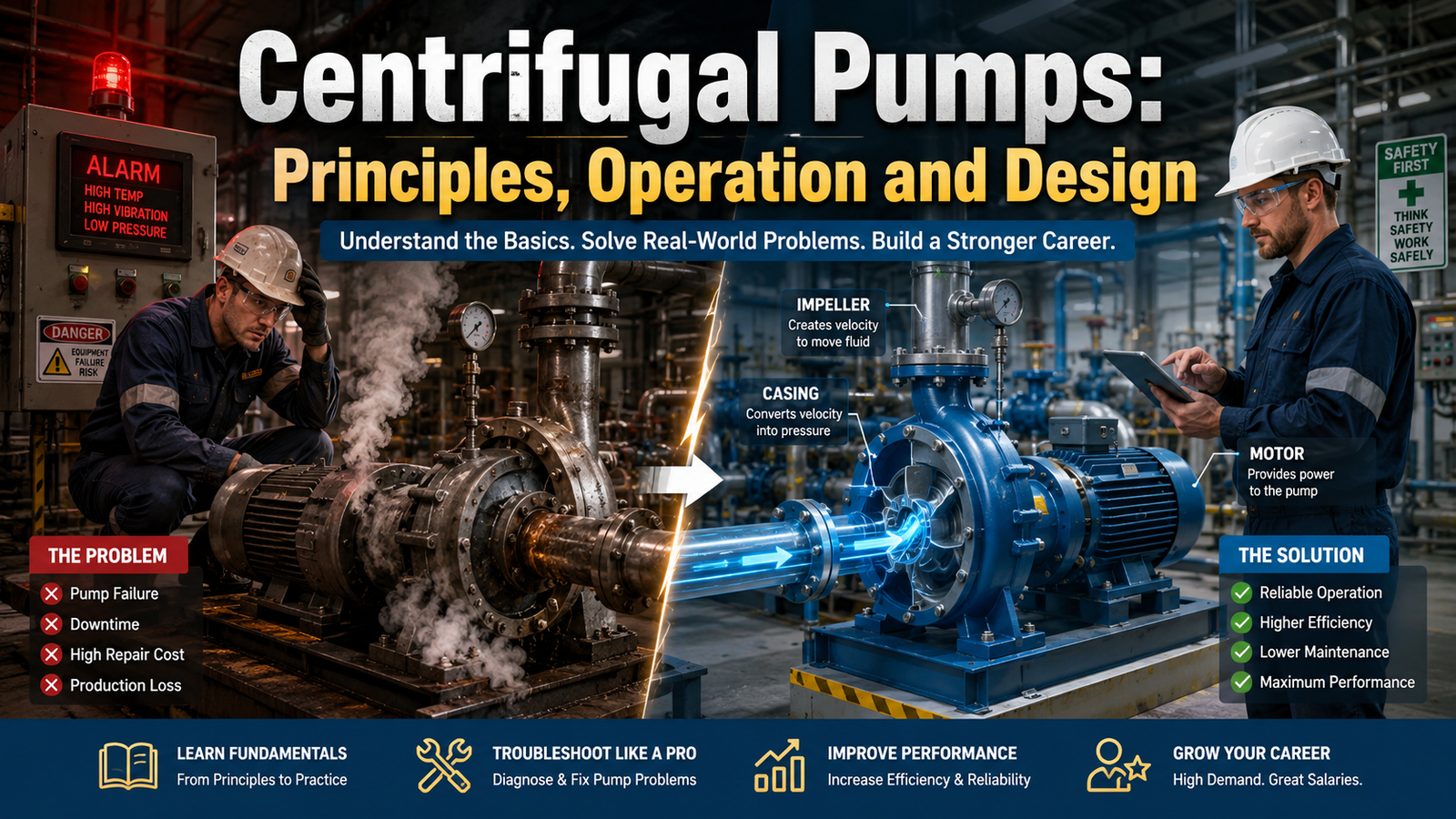
Every part of a centrifugal pump has a specific role. Understanding them helps you troubleshoot faster and make smarter maintenance decisions.
- Impeller: The rotating heart of the pump. Its size and blade design determine flow rate and pressure.
- Casing (Volute): Surrounds the impeller. Its shape converts fluid velocity into pressure energy.
- Shaft: Connects the motor to the impeller. Must be balanced to prevent vibration.
- Bearings: Support the shaft and reduce friction. Regular lubrication is essential.
- Mechanical Seal: Prevents fluid from leaking along the shaft. One of the most common wear items.
- Wear Rings: Reduce internal leakage between impeller and casing, improving efficiency.
Design directly affects efficiency. A poorly designed or incorrectly selected pump can consume 20-30% more energy than needed — costing your plant thousands in electricity every year. Good engineers know how to match the pump design to the job.
👉 Start learning Centrifugal pumps : Principles , Operation and Design course here: https://trk.udemy.com/2RdK77
👉 Get full subscription access: https://trk.udemy.com/PzKGrq
Why Learning This Skill Can Transform Your Career:
The U.S. Bureau of Labor Statistics consistently shows strong demand for industrial maintenance and mechanical engineering roles. Here’s why centrifugal pump knowledge pays off:
- Maintenance Technicians with pump expertise earn $50,000–$75,000/year on average
- Plant Engineers and Process Engineers in oil & gas routinely earn $80,000–$110,000+
- Reliability Engineers (focused on preventing failures) are among the most in-demand roles in manufacturing
- Industries like chemical processing, water utilities, and energy are actively hiring in all 50 states
Beyond the salary, there’s job security. Pumps don’t maintain themselves. As long as industries operate, they need people who understand this equipment — and that’s not changing anytime soon.
Ready to Learn? This Udemy Course Gets You There:
If you’ve been looking for a practical, beginner-friendly way to master centrifugal pumps — this Udemy course is built for you.
The course covers everything from the fundamental working principles to real-world design and operational scenarios used in American industries. No prior engineering degree required.
What you’ll learn:
- How centrifugal pumps work — from physics to practice
- Pump components, design selection, and performance curves
- Common faults, how to diagnose them, and how to fix them
- Energy efficiency and optimization strategies for plant environments
- Industry standards used in the U.S. oil, gas, water, and chemical sectors
Why this course stands out:
- 100% beginner-friendly — no background knowledge needed
- Self-paced learning — study on your schedule, from anywhere
- Certificate of completion — add it to your LinkedIn or resume immediately
- Practical focus — not just theory; real tools you can use on the job
What Students Are Saying:
| ⭐⭐⭐⭐⭐ James R., Maintenance Technician — Dallas, TX “I had been working around pumps for years but never truly understood why things went wrong. This course changed that. Within two weeks I diagnosed a cavitation issue at our plant that we’d been chasing for months. My supervisor noticed. Highly recommended.” |
| ⭐⭐⭐⭐⭐ Maria L., Engineering Student — Chicago, IL “I was preparing for job interviews in the chemical industry and needed practical knowledge fast. This course gave me exactly that. I walked into my interview confident and landed the role. The course pays for itself.” |
| ⭐⭐⭐⭐⭐ Derek M., Plant Operator — Houston, TX “Plain English, no fluff. The instructor explains things the way a real engineer talks — not like a textbook. I watched the whole thing in a weekend and took my certificate straight to my manager. Best $20 I’ve spent on my career.” |
Our Commitment: Practical, Honest, Expert Content:
This guide was written by industry professionals with hands-on experience in fluid systems and mechanical engineering. The content reflects real-world usage across U.S. industries — not just textbook theory.
We believe in straightforward education. We’re not going to oversell a course to you. What we will tell you is this: understanding centrifugal pumps is a skill with measurable career and financial value — and the right training accelerates that journey significantly.
The Udemy course recommended here has been reviewed for content quality, instructor credibility, and alignment with industry standards used in the United States.
Conclusion: Knowledge Prevents Failure — in Pumps and Careers:
Centrifugal pumps keep the world’s industries running. Water flows, chemicals process, oil moves — because these machines work around the clock. The people who understand them are always in demand.
You’ve now got a solid foundation: you know what a centrifugal pump is, how it works, what makes it tick, and why its design matters. That’s more than most people walking into an interview know.
The next step? Go deeper. The Udemy course takes everything you’ve learned here and turns it into practical, job-ready knowledge — complete with a certificate you can show the world.